Light makes photography. Embrace light. Admire it. Love it. But above all, know light. Know it for all you are worth, and you will know the key to photography.

— George Eastman.


Saturday, August 25, 2012

Seeing Black and White

In a B&W photography forum I recently asked, "How many of us 'see' in B&W? What does it mean to 'see' in B&W? How is it different from seeing in color? Is it simply a matter of visualization? Is it a state of mind?" So far the responses have been interesting. Initially it seemed it would become a discussion about color blindness. Then, when it came up tangentially in another forum, where it quickly lead to a film vs digital debate.

Here is what it means for me:

George Eastman said, “Light makes photography.... Know it for all you are worth, and you will know the key to photography.” Regardless of color or B&W, film or digital, we must know light, and we have to think in terms of light, shadow, brightness and darkness.

For B&W, or monochrome, I do not physically see in monochrome. I can, and do, however visualize in monorchorme. I think this was enabled by learning photography with B&W film and being trained in the Zone System. Even if I am not using a spot meter to measure light and shadow, I am still calculating where black and white will be, what shadow and hightlight details will be like. Ansel Adams said, "To visualize an image (in whole or in part) is to see clearly in the mind prior to exposure, a continuous projection from composing the image through the final print.” This is what I have learned to do in 35 years of photography. So do I see in B&W? Not physically, but I certainly visualize in B&W, I "think" in B&W. The idea that one can only "see" in B&W when shooting B&W film is incomprehensible to me.

I think I also benifitted from processing my own film and making my own prints. There are a limited number of shades of luminosity that we can perceive in color or B&W and there is a calculation that takes place for me in how I will fit a given scene and its range of light into an image for eventual printing. For me, "In the beginning it is all about light, in the end it is all about the print."

These calculations take place almost subconsciously. I only shoot in manual mode and I always shoot RAW. I scout my environment first, evaluating the light and choosing my exposure, then having made those decisions, I concentrate on what I see in my viewfinder. For this point on, it is all about composition.
So, for me, "seeing" in B&W is a visualization and a state of mind. I do "see" in B&W.


Booth's Mill Bridge on Antietam Creek, Washington County, MD

Thursday, July 26, 2012

The Man Behind the Curtain

The topic of Photoshop has come up this week in several forums of which I am a member. It has come up in context of the question “did you Photoshop that?” The implication is that using Photoshop is somehow bad or artificial—a “manipulation” of reality. I was stung by this accusation recently when someone said critically that I had "over-manipulated" the sky in a photo. The reality was that the photo was taken on a perfect day with perfect clouds and the only manipulation was the use of a polarizing filter at exposure. To the inexperienced eye, it must have been "Photoshopped".

This question never goes away to my amazement. In the "wet process" days, no one ever asked me "did you 'darkroom' that?" Photoshop is my digital darkroom. I can do little in Photoshop that I couldn't or didn't do with film and the darkroom. Ansel Adams said, “To visualize an image (in whole or in part) is to see clearly in the mind prior to exposure, a continuous projection from composing the image through the final print.” Using Adams’ Zone System, prior to exposure, I choose whether to overexpose or underexpose my film. Then I adjust my development time, under or over, to compensate for my exposure. That was just the beginning of “manipulation” of the image through the final print.
Digital technology is ubiquitous: when every cell phone is a camera, the curtain has been pulled back and the Great Oz revealed as the little man behind the curtain. Where people used to admire prints made with skill and artistry, today they ask, "is it Photoshopped?" It is demeaning to a well-made print and this affects all digital art. With drawing, paints or watercolor, the focus is on the work of art; with digital media, the focus is on the software, as if Illustrator also lessens a work of art.
There is a steep learning curve required to get the maximum out of Photoshop. As always, it takes a good eye, training and experience to get outstanding prints. Yes, the curtain has been pulled back, but, in the end, the wizard still had a brain, a heart and courage. Whether using Photoshop or a darkroom, good prints will still always be good prints.

Wednesday, July 25, 2012

Photography Is Not A Crime


D.C. Chief of Police — Photography Is Not a Crime.

On July 19, 2012 Washington D.C. Chief of Police Cathy L. Lanier signed General Order GO-OPS-304.19.
The new policy states, "The Metropolitan Police Department (MPD) recognizes that members of the general public have a First Amendment right to video record, photograph, and/or audio record MPD members while MPD members are conducting official business or while acting in an official capacity in any public space, unless such recordings interfere with police activity."

The new regulation says, "Members are reminded that photography, including videotaping, of places, buildings, structures and events are common and lawful activities in Washington, D.C."
"In areas open to the public, members shall allow bystanders the same access for photography as is given to members of the news media. Members shall be aware that:

  1. A bystander has the same right to take photographs or make recordings as a member of the media, as long as the bystander has a legal right to be present where he or she is located.
  2. A bystander has the right under the First Amendment to observe and record members in the public discharge of their duties.
  3. Public settings include, e.g., parks, sidewalks, streets, and locations of public protests; but that protection extends also to an individual’s home or business, common areas of public and private facilities and buildings, and any other public or private facility at which the individual has a legal right to be present."
"...members shall not inform or instruct people that photographing or recording of police officers, police activity or individuals who are the subject of police action...is not allowed; requires a permit; or requires the member’s consent. Additionally, members shall not:
  1. Order that person to cease such activity;
  2. Demand that person's identification;
  3. Demand that the person state a reason why he or she is taking photographs or recording;
  4. Detain that person;
  5. Intentionally block or obstruct cameras or recording devices; or
  6. In any way threaten, intimidate or otherwise discourage an individual from recording members’ enforcement activities."
The full text of the General Order, signed by Chief of Police Cathy L. Lanier is available here:
http://legaltimes.typepad.com/files/go_304_19.pdf

This follows a similar General Order issued in Baltimore in February 2012. That General Order said that Baltimore police officers may not "prevent or prohibit" photographing or taking video of law enforcement activities. Both General Orders were partially in response to federal lawsuits involving both police departments. This is an important issue for more than just professional photographers. The ubiquity of cell phone cameras makes this an important First Amendment issue for everyone.

Saturday, June 30, 2012

What is Education?

Someone asked recently what photographers, noted for their work, were self-taught. The list is long, Daguerre, Matthew Brady, William Henry Jackson, Alfred Stieglitz, Edward Steichen, Edward Weston, Ansel Adams, Arnold Newman, Margaret Bourke-White, Ilse Bing, Philippe Halsman, Irving Penn and the list goes on and on.

Then I wondered, "Do I count?" I got my first camera, a Kodak Brownie Hawkeye, when I was five. No one "taught" me photography but I grew up in a household where a new Life and Look magazine arrived weekly and National Geographic came every month. I was always trying to figure out how they got those photos. It did not occur to me for years that they weren't using Brownies as well. As I got older, I studied Ansel Adams' books and Minor White's book on the Zone System and Aaron Sussman's "The Amateur Photographer's Handbook. Then I knew that those photographers were not using Brownies and I began saving to buy a Nikon. Although I was photo editor and a photographer for my college yearbook, I majored in economics. Now, without the formal training or degree in photography, art, fine art, etc., I am teaching photography at a local college.

Personally, I don't think of myself as "self-taught", but maybe self-educated. I learned photography from the great photographers of Look, Life, and National Geographic. I was "taught" by masters of photography, Steichen, Stieglitz, Adams, Minor White, Margaret Bourke-White, and master photography educator Aaron Sussman and the chemists and engineers at Kodak. What do you think; do I count as "self-taught"? Or, are we all indebted to those photographers that we have had contact with that came before us, regardless of our "education"

Thursday, June 21, 2012

Gigapixels?

I saw it reported today in LiveScience.com that Duke University has built a camera that takes 1 gigapixel images. What? Gigapixel? For someone who has been longing for the 36 megapixel Nikon D800 I had to stop and think a moment. Yep, 1 gigapixel. That is 1,000 megapixels. Talk about large format digital. The article then went on to say that they are now in the manufacturing phase of a 10 gigapixel camera. That is more than 275 times the image size of the Nikon D800 and almost 420 times the image size of the new Nikon D3200.

Duke University's One Gigapixel Camera
So, out of curiosity, I decided to Google  "gigapixel camera" and was really surprised. Aquatic-photography.com has a picture of a 4 gigapixel camera that is described as being able to "shoot 4 football fields and capture every blade of grass". Then I see where Microsoft Research in Beijing has a 1.6 gigapixel camera that looks very much like a conventional view camera.

David Brady of Duke University is quoted in the journal Nature as saying that the camera "records a one gigapixel image in less than a 10th of a second", capturing details invisible to the human eye. The article then goes on to say that as the electronics improve, the price should become affordable for professional and serious amature photographers within about 5 years.

So, there it is, not one but several gigapixle-plus cameras that today cost a $100,000 to $250,000 dollars and in 5 years I should be longing for Nikon's latest gigapixel DLSR.

I am saddened by several things around this story, however. I've posted about my experiences with digital photography previously. I mourn the condition of Kodak, which as much as anything or anyone helped shape my photography. Remember that digital photography was invented by Kodak—here, in the United States. As recently as 2005 Kodak was number one in digital camera sales in the United States. Now, not only is Kodak in bankruptcy, it is trying to sell its patents for digital photography and, most recently, has sued Apple to keep them from interfering with the sale of those patents. So, what do I have to look forward to in my dreams of a gigapixel Nikon?
I'm concerned that not only is Microsoft building gigapixel cameras, but they are doing it in China! I would be much happier buying my gigapixel Nikon if it said "MADE IN USA". Why is it that Honda, Toyota, Nissan, Hyundai, Kia, Volkswagen, BMW and Mercedes build cars in the US and make a profit and GM couldn't. How did Kodak, the inventor of digital photography, not only let their previous business (film) get away from them, but so badly fumbled on digital photography? I guess the best I can hope for is some American company buying Kodak's patents. I'm just afraid that if that buyer is Apple or Microsoft they will have no problem figuring out how to monetize those patents at the expense of all photographers.

Sunday, June 17, 2012

Shaker Village at Pleasant Hill, KY


Shaker House Seen Through Gate
There is a new gallery on my website humphries-russ.com. Shaker Village features six images from the Shaker Village of Pleasant Hill, KY, which was an active Shaker religious community from 1805 to 1910. This 3000 acre National Historic Landmark is America's largest restored Shaker community and features 34 restored buildings. 

These six images are from the earliest days of digital photography. Shot in August of 1994 on Kodak TRI-X Pan film with a Nikon F3, Kodak, the inventor of digital photography, processed these images in a format called “Photo CD”. These 6.3 megapixel images measured 21⅓ x 32 inches at their native resolution. Characteristically, the images feature the high contrast and rich detail of TRI-X Pan. Printed full frame, the only instance of noticeable grain is in the sky of Shaker House Seen Through Gate, where it lends a painterly, impressionistic quality to the image.

Previously existing only as monoprints in my private collection, I now offer them in limited edition, signed and numbered prints in sizes from 13 x 19 inches to 40 x 60 inches. Featuring historic subjects, I created these images with an historic, and now obsolete, digital process.


Tags: Kodak, Kodak Photo CD, Kodak DCS 460, Kodak History, Kodak 1990-1999, Shaker Village, Pleasant Hill, KY

Wednesday, April 25, 2012

My favorite camera

Someone asked recently what my favorite camera was. Without hesitation, I answered, "my Kodak Brownie Hawkeye". I was given this camera when I was 5 years old and it is why I became a photographer. Over the years I have had many current favored camers; my Nikon FTn, my Nikon F3s and currently my Nikon D7000s. I also collect cameras. It all started with that Kodak Brownie. The Hawkeye is a fixed focus, fixed aperature, fixed shutter speed, 2¼ inch square format camera with an optional flash attachment. But it takes sharp pictures on 620 or re-rolled 120 film and the contact prints are sharp, fine-grained and have high contrast. Over the years I've had many more capable cameras, but what the Hawkeye did was magic—it made me a photographer.

Friday, February 24, 2012

Kodak and Digital Photography circa 1994

The The recent press coverage and various discussions about Kodak’s bankruptcy filing last month caused me to start thinking about the major role Kodak has played in my photographic life. From my first camera, a Kodak Brownie Hawkeye, through Kodachrome, Ektachrome and Tri-X PAN to the APS-C format sensor in my Nikon D7000s, Kodak has always been a major presence. The comments that Kodak invented digital still photography made me think specifically about my early days with digital photography.


My experience with digital photography began in 1994 with the Kodak Photo CD. Photo CD was a system of digitizing and storing up to 100 photos in a proprietary format at 5 different resolutions up to 6.3 megapixels. Photo CD Pro Master discs had 25 photos in 6 resolutions up to 25 megapixels. At the time, for Photo CD, I was shooting Kodak Royal Gold at ASA 100 and 400 with Nikon F3s and prime NIKKOR lenses. I would have my film processed by Kodak and would receive negatives, prints and a Photo CD with the photos for about $1 a frame. This was a big deal in 1994; digital photography in 1994 was expensive. The alternatives were more expensive drum scans of negatives and transparencies or the Kodak DCS 460. The DCS 460 was a Kodak digital back mated to a Nikon N90s body; it had 6 megapixels and retailed for $28,500 (about $43,500 in today’s dollars).
Kodak DCS 460

The Photo CD route to digital photography had its own costs too. Processing digital photos in Photoshop required very robust hardware. I used a custom built Windows based PC spec’d as follows:
·   Processor/BIOS/Bus:             
o   AMD 386DX-40 - this was actually faster than an Intel 486DX-33
o   AMD 80387DX Coprocessor
o   AMI Bios
o   EISA Bus

·   Memory
o   32 MB – 4 MB SIMMS in 8 Slots

·   SCSI Drive System
o   Adaptec AHA-1742A EISA SCSI-2 Card in Enhanced Mode
o   250 MB HDD - System Partition
o   1 GB Toshiba HDD - Applications, Fonts, etc.
o   1 GB Toshiba HDD - Data
o   SyQuest SQ3270 - 270 MB
o   Iomega Zip Drive - 100 MB
o   NEC CD-ROM
o   HP ScanJet IIC
o   2 Sony 1.44 Floppy Drives

·   Video
o   Diamond Stealth PRO Video Card with 4 MB RAM
o   NEC 21 in. flat/square monitor, .28 dot pitch , 75 Hz refresh rate

The operating system was Windows for Workgroups 3.11 over MS-DOS 6.22. My applications were Aldus PageMaker 4.0, Adobe Photoshop 3.0, Adobe Illustrator 4.0, CorelDraw 3.0, Adobe Type Manager for Windows 2.0, Microsoft Excel for Windows 4.0 and Microsoft Word for Windows 2.0.

Workflow with Photo CD images was to open the Base image, 512 x 768 pixels or about a 1.2 MB file, turn on a macro recorder and then start editing the base image. The macro recorder captured mouse clicks and keystrokes, saving them for later. At the end of the day, you would close all your applications and restart your computer, ensuring a clean machine with fully available resources. Then you would launch Photoshop, open the 16 Base image, 2048 x 3072 pixels or an 18 MB file, launch the macro and go home for the night. If all went well, you had an edited 16 base image in the morning. With a resolution of 96 dpi, the 16 Base image had what Kodak described as a “poster” size of 32 x 21 inches. At 300 dpi this yielded an image approximately 6 ¾ x 10 ¼ inches.

Another cost of digital photography in those early years was time. Since final image editing was automated and occurred overnight, this didn’t really count. The major time investment in those days was waiting for screen redraws. Forget about “previews” as we think of them today. Even with a fast processor, coprocessor and lots of memory, video was the big bottleneck. Even with video acceleration, it took seemingly forever for the image to redraw on the screen. The only solution to this was the fastest video card you could afford with as much video memory as possible.

One final word about memory; it is true today that Windows loves memory, it was even more so in 1994. By contemporary standards, the 32 MB of RAM that I had was outrageous. This amount of memory contributed to my system being fast and stable; I did not experience the “Blue Screen of Death” that so many complained about. Having 32 MB of RAM installed allowed me to run Photoshop and PageMaker at the same time and still have a print job running in the background. It was an unusual, but necessary, luxury to be afforded so much memory. By comparison, today I am running an Intel Core i7-3960X with 32 GB of RAM installed for which I paid considerably less than that 386-DX40 from 1994. Thank-you Gordon Moore.


Steven L. Sasson inventor of the
world's first digital still camera,
.01 megapixels.

Friday, January 13, 2012

Technology—Photoshop

When I started shooting professionally, the big technological innovation was TTL metering. WOW! I shot film for over 35 years and because of my process and the way I was trained, I spent as much time in the darkroom as I did behind the camera.
I've heard a lot of discussion about the "evils" of Photoshop recently. Personally, there is nothing I can do in Photoshop that couldn't be done in a darkroom. Photoshop does make it a lot easier to do. Is digital the same as film? No. But then Tri-X Pan wasn't Kodachrome either. Different media, different processes, different results--but great results were produced with both. I admit, I was a late-comer to digital cameras—my F3s had to be pried from my fingers. I love my Nikon DSLRs. I have had to change my processes, but everything I learned is still relevent—focal length, ISO, aperature, shutter speed, depth of field, zone system, etc.
I think some people get lost in thinking of it as only a qualitative question. My 16-year old son is fond of asking things like, "which is better, a Ferrari or a Taurus?" It really isn't a fair comparison of values or qualities, it is a comparison of differences. Digital is different from film, but that doesn't make it any better or worse.
I still shoot both, I still shoot the same way, and my back-end processes are completely different. Obviously the results are different, but one media is no more or less art than the other. As Trent said, "they are all just tools to me."

Saturday, June 18, 2011

Color

 Green Doors at St. Paul's
Nikon D60 w/ Nikkor 10-24mm f/3.5-4.5 lens
10mm, 1/125 sec, f/8, ISO 400 Manual exposure


Brake Wheel and Railroad Cars
Nikon D60 w/ Nikkor 55-300mm f/4.5-5.6 lens
116mm, 1/200 sec, f/4.8, ISO 200 Auto exposure


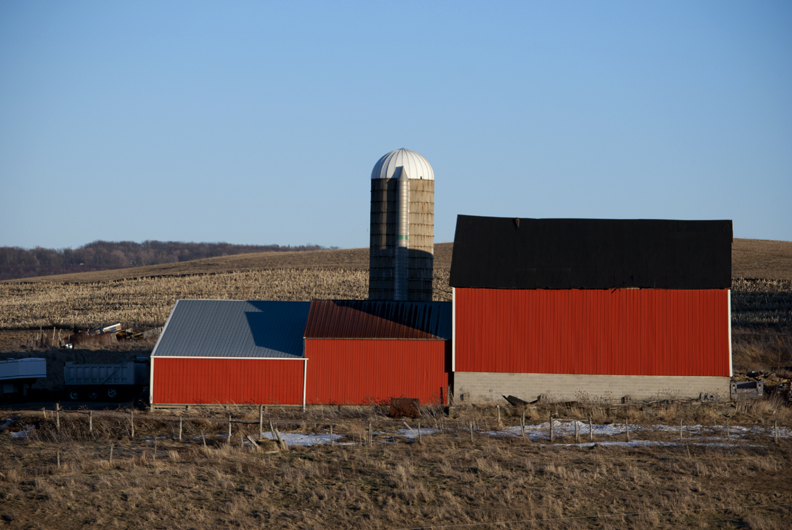
Red Barn
Nikon D60 w/ Nikkor 55-300mm f/4.5-5.6 lens
120mm, 1/500 sec, f/8, ISO 160 Auto exposure


Purple House, Green Shutters
Nikon D60 w/ Nikkor 10-24mm f/3.5-4.5 lens
14mm, 1/125 sec, f/8, ISO 400 Manual exposure 


Playground Primaries
Nikon D60 w/ Nikkor 10-24mm f/3.5-4.5 lens
10mm, 1/160 sec, f/7.1, ISO 400 Manual exposure


Power Tower
Nikon D60 w/ Nikkor 10-24mm f/3.5-4.5 lens
10mm, 1/320 sec, f/9, ISO 100 Auto exposure


Chain
Nikon D60 w/ Nikkor 18-55mm f/3.5-5.6 lens
55mm, 1/30 sec, f/5.6, ISO 400 Manual exposure